Athlete Made Easy
Get more athletic: one 10-day cycle to jump, sprint, lift and stretch. Add reps, then weight. Your jump test keeps score.

- Level
- New to training through advanced
- Session
- It depends on the day. The app shows an estimate before you start.
- Equipment
- A full gym is ideal. The app fits the program to what you have.
- Length
- One 10-day cycle, repeated. No end date.
All 10 days, then repeat
It's all here before you sign up. Open a day to see what's in it.
D1Jump
Easy cardio and holds, a court warm-up, 10–15 build-up jumps, then 15–20 max jumps. Your first jump day is your jump test. You test again on the jump day after a deload, or when six weeks have gone by since your last test.
D2Lower body
Power cleans, front squats, deadlifts and standing calf raises, then crunches and hanging leg raises.
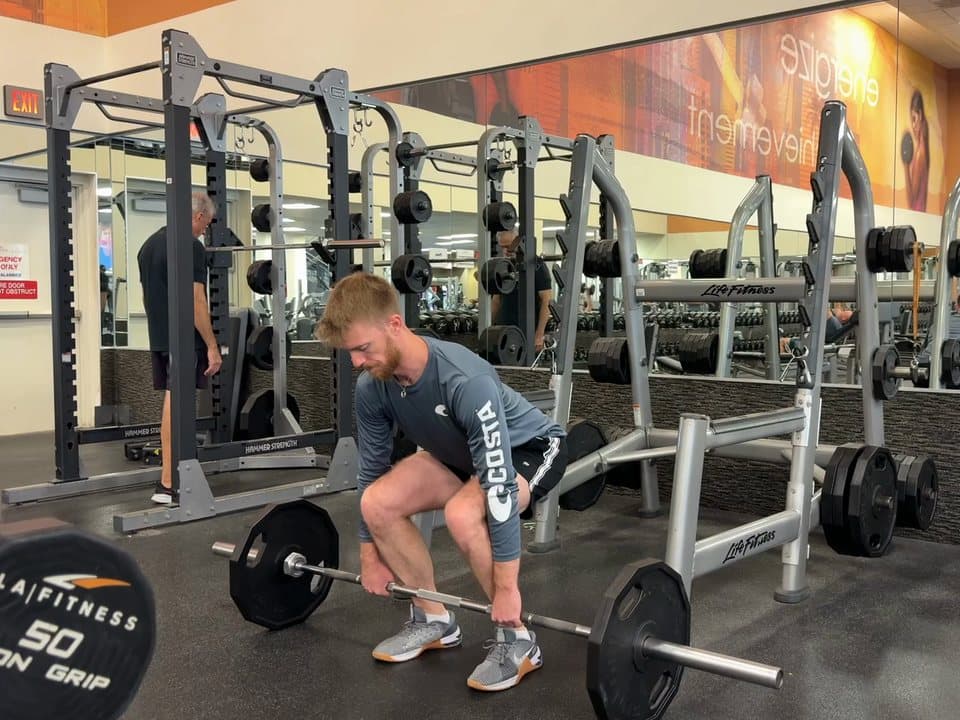
Power clean 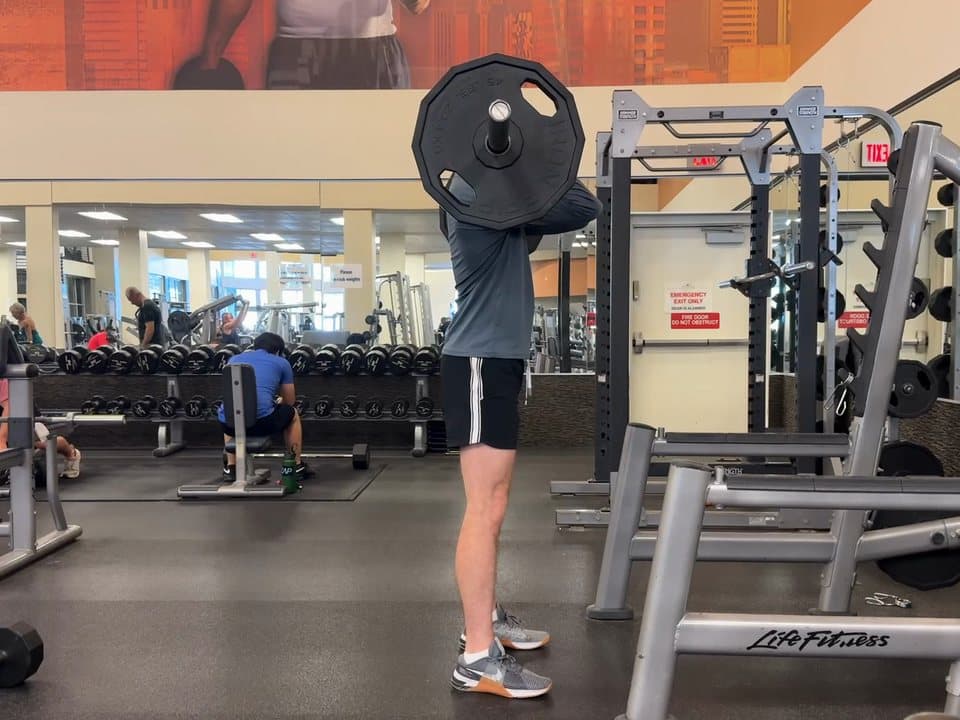
Front squat D3Push-ups + rows
Push-ups and inverted rows, then curls and triceps, then two moves for your lower back.
D4Flexibility + endurance
30–45 minutes of easy cardio, easy enough that you can still talk, then 2-minute stretches from your feet up to your hips.
D5Rest
A shake out, just to get the blood flowing: 10 minutes of easy cardio and the court warm-up, then stop. You should do it, but it's optional.
D6Sprint
A skip warm-up, 5–6 easy build-up sprints, then 6 all-out 20-meter sprints with full rest between them.
D7Single-leg
Power cleans, Bulgarian split squats, Nordic curls and seated calf raises, then crunches and hanging leg raises.
Power clean 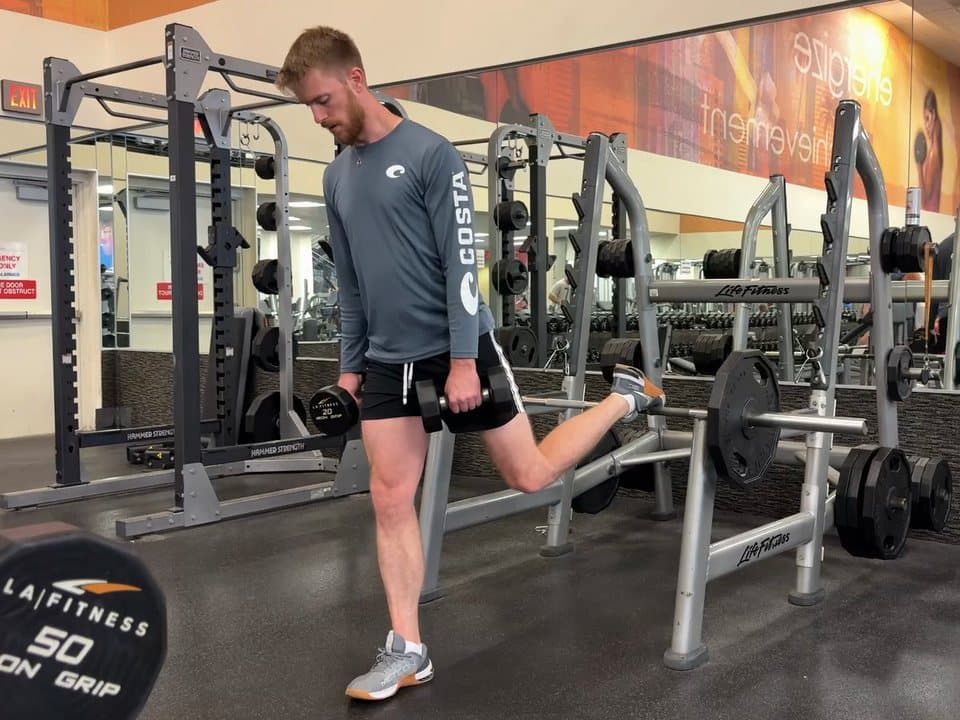
Bulgarian split squat D8Chin-ups + dips
Chin-ups and dips, then curls and triceps, then two moves for your lower back.
D9Flexibility + endurance
The same as day 4.
D10Rest
The same as day 5.
Jump, sprint and lift days all start the same way: 10 minutes of easy cardio, then holds for your legs and calves.
A jump day, start to finish
- 0110 minutes of easy cardio. Jog, bike, walk or push a sled.
- 02Holds: a split squat and a calf hold, 3 sets of 30 seconds on each side, at about 60–70% effort. Hold still, never shaking.
- 03A court warm-up: jogs, skips, karaoke, zigzags, butt kicks and leg swings.
- 0410–15 build-up jumps, from about 20% effort up to about 90%.
- 0515–20 max jumps with a full run-up, one at a time, with full rest between them. Log how many you did.
The stop rule. Two or three low jumps in a row, or feeling weak and slow? You're done for today, even if you haven't hit the number. That's the program working, not you failing. If pain gets worse as you jump, stop.

Reps first, then weight.
Every lift has a rep range: 3–6 on the main lifts, 6–12 on accessories and 8–15 on core. Every working set counts on its own.
- 01Start light: a weight you can easily lift for the top of the range on every working set.
- 02Each session, aim for one more rep on every working set.
- 03When every working set hits the top of the range, add a little weight: 5 or 10 lb (2.5 or 5 kg) on the big lifts, less on the small ones. Your reps drop back toward the bottom, and you climb again.
- 04Can't add reps two sessions in a row? Go lighter by half of the weight you last added, and build the reps back up.
- The power clean is the one exception: always 3 sets of 3. Add weight while all three sets stay clean.
- Working sets stop about 2 reps short of failure. Warm-up sets come first and don't count as working sets.
- The app does the math: from what you log, it gives you the next session's weight and the reps to aim for.

Bodyweight lifts count your bodyweight.
Push-ups, rows, chin-ups and dips follow the same rule, with your bodyweight as part of the load. Need help to hit the reps with good form? Start assisted, climb the reps, then take away a little help at a time. At bodyweight, climb until you can add weight.
Push-upsAbout 64% of your bodyweight, 49% on your knees

Inverted rowsAbout 73% of your bodyweight, 76% with your feet raised

Chin-upsAll of your bodyweight

DipsAll of your bodyweight


Full gym, or less.
It's written for a full gym. Tell the app what you have, and it gives you the version of each lift you can do there. The charts show the versions setup by setup, and which lifts have none. Read each chart left to right as the equipment runs out.


Not on the charts? The warm-ups, jumps, sprints, push-ups, stretches and cardio work in every setup. No yoga block for the shin stretch? Use a book.
You do the work. The app keeps track.
Every set, logged
Put in your weight and reps as you go. On jump days, log how many max jumps you did.
Your next session, worked out
From what you log, the app sets your next session: the weight and the reps to aim for. It also tracks your strength for your size, bounce, speed and body composition.
A report card every month
On the 1st, you get a report card for the month before.
An AME coach, if you want one
Message your coach and send videos, as many as you like. Coaching is $50 a month or $500 a year. The first 14 days are free, once per person. The weekly group call is free.

Before you start
Do I need a gym?
No. A full gym is ideal, but the app fits the program to what you have: a full gym, dumbbells and a barbell, dumbbells only, a barbell with no dumbbells, or nothing at all. You get the version of each lift you can do there. If a lift has no version for your setup, the workout tells you and leaves it out. The charts on this page show the versions, setup by setup.
How long does a session take?
It depends on the day. Rest days are a short shake out, and even that's optional. The app shows an estimate for the day before you start it, and that estimate sharpens as you log your sessions.
When does it end?
It has no end date. You repeat the same 10 days, adding reps and then weight, for as long as it's working for you.
How do I know it's working?
Your lifts show it as you go, in the weights and reps you log. Your first jump day is your starting jump test. You test again on the jump day after each deload, or when six weeks have gone by since your last test. Test it one of three ways: film it and mark the frames, measure your reach and touch, or use a Vertec or jump mat. Only tests done the same way are compared.
I'm new to training. Is this too much?
No. Start light, with a weight you can easily lift for the top of the range on every set. New to lifting? Start very light and just learn the movement. And a jump day ends early once your jumps start dropping.
Is this only for jumpers?
No. It's for anyone who wants to be more athletic, whatever you play. Each cycle has a jump day, a sprint day, four lift days and two flexibility days. Your jump is tested on day one, after each deload, and any time six weeks go by without a test, because how high you jump is the clearest sign you're getting more athletic.
What if I miss a day?
It moves to your next training day, so you pick up where you left off. Keep both rest days. If one lands on a day you don't train anyway, that day is your rest.
I'm under 18. Can I use it?
Yes, if you're 13 or older. You sign up and train like anyone else. We can't make an account for anyone under 13.
Does it cost anything?
The app, the programs and everything for teams are free, for good. Coaching is $50 a month or $500 a year, if you want it. The first 14 days are free, once per person. We email account holders before a price changes or anything new costs money.
Day 1 sets your starting numbers.
Start the program and log your first session.